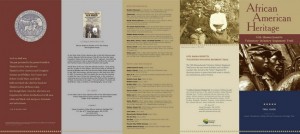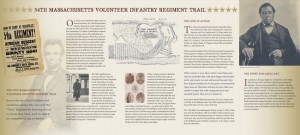
 The 54th Massachusetts Volunteer Infantry Regiment, one of the first official African American units in the United States during the Civil War, was comprised of men from Berkshire County, Mass. and Litchfield County, Conn. The story of the unit, including its struggle for equal pay, was depicted in the 1989 film “Glory.” The MASS 54th Trail is the most recent addition to the African American Heritage Trail, a program of Housatonic Heritage.
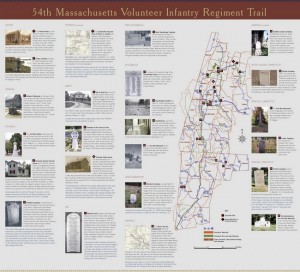
In 2011, a book, “On the Other Side of Glory,” was written by anthropologist David Levinson and Emilie Piper and published by Housatonic Heritage. The MASS 54th Trail includes 24 sites – homes, churches, cemeteries, monuments – in twelve communities, from Dalton, Mass. to Sharon, Conn. Each site is associated with an African American man or group of men who served in the 54th. A self-guided tour brochure will be unveiled at the reception. This brochure directs visitors to places regiment members lived, went to church, are memorialized, and buried.
The “MASS 54th” interpretive trail is the most recent addition to the African American Heritage Trail, a program of the Housatonic Heritage. The African American Heritage Trail celebrates African Americans in the Upper Housatonic region, ordinary people of achievement and those who played pivotal roles in key national and international events—W.E.B. Du Bois, Elizabeth “Mumbet” Freeman, James Weldon Johnson, Rev. Samuel Harrison, James VanDerZee, and others. More information about the trail can be found at www.africanamericantrail.org/54th-massachusetts-volunteer-infantry-regiment-trail/.
54th Massachusetts Volunteer Infantry Regiment Trail

A self-guided motor tour of 24 sites in 12 communities from Dalton MA to Sharon CT honoring the men from Berkshire and Litchfield counties who served in the “Glory” regiment by directing visitors to places they lived, went to church, are remembered, and are buried.
A more complete story of the ‘Mass 54th’ by anthropologist David Levinson
The Glory Trail – 54th MA Volunteer Infantry Regiment in the Civil War
David Levinson, PhD.
July 2025
Introduction
This trail covers the activities of the 54th Massachusetts Infantry Regiment from June 1863 through August 1965 in South Carolina, Georgia, and Florida. This Trail is meant to extend and compliment the Upper Housatonic Valley African American Heritage Trail, established in 2006 and the derivative Berkshires 54th Trail which include a number of sites (monuments and graves) related to men who served in the 54th. This southern trail is meant to show what the regiment and these Berkshire men in particular did during the Civil War that merited the numerous and various forms of recognition and admiration they received during and following the War.
Along the Trail you will find more than 20 sites, including battlefields, antebellum mansions used as Civil War hospitals, churches and praise houses, Reconstruction era schools, houses, monuments, statues, historic markers, and the Beaufort National Cemetery.
Download the Brochure
CLICK for a PDF version of the print brochure.

History
The 54th Massachusetts Volunteer Infantry Regiment was the second all-Black (the officers were white) Union military unit recruited, mustered, and trained in the North and then deployed to fight in the South. The first was the 1st Kansas Colored Volunteer Infantry Regiment and both were preceded by several units of former slaves in Louisiana and South Carolina. The 54th mustered into service on May 13, 1863 and out of service on August 20, 1865. It was reinstated as a ceremonial Massachusetts National Guard unit in 2008.

1st South Carolina Infantry historic marker in front the Beaufort National Cemetery, 2025. Source: David Levinson.
Over its two-plus years of service about 1,500 men served in the regiment; participating in one raid, five battles, several skirmishes, two sieges, as well as constructing fortifications and guarding Confederate prisoners in South Carolina, Georgia, and Florida. It took more casualties than most other units, white or Black, due to their leading assaults against entrenched Confederate infantry and artillery and taking on dangerous military missions (see below).
Depending on how one classifies place of residence, 82 to 87 men from Berkshire County communities served in the 54th. This was a substantial percentage of the 529 Black males in the county in 1860, most of whom were too young or old or unfit to serve. The Berkshire men saw much action and paid for it. Twenty-eight percent were classified as casualties (killed or wounded in combat, died of diseases, accident victims), considerably higher than the 19.2% for the entire regiment.
Following training at Camp Meigs outside Boston under the command of Colonel Robert Gould Shaw (1837 – 1863), the son of Boston abolitionists and a veteran of Antietam, the regiment of 1,000 men departed by steamer for Beaufort, South Carolina. They were sent off with much fanfare, concluding with a parade down State Street to the steamer.
Impact and Significance
The 54th Massachusetts Volunteer Infantry Regiment is, according to many, the best known and most celebrated of the hundreds of military units which served in the Civil War. This fame, no doubt, is due in large part, to the 1989 film, Glory, which also led to the regiment being labeled, “The Glory Regiment.” Beyond the film, the 54th’s story is told in dozens of books, school curricula, mentioned often on historical markers and monuments, and is the focus of websites far too numerous to count.
And, the same can be said of its first commander, the 25-year old Col. Robert Gould Shaw, who trained and led the regiment for just six months before being killed at Ft. Wagner in July 1863. Honoring his service is the famous Shaw 54th Regiment Memorial in Boston, with Grand Army of the Republic (GAR) posts were named after him, as were schools, and like his regiment, numerous books and websites tell us about his service.

Col. Robert Gould Shaw. Source: Lenox Historical Society.
Viewed within the overall context of the long and bloody Civil War, this level of attention and celebrity looks surprising. After all, the 54th’s entered the war two years after it began and its service was more limited than many other units. It participated in no major campaigns nor battles such as Antietam, Vicksburg, or Gettysburg. The five battles it did fight in were all relatively minor ones, and the two most significant, Ft. Wagner and Olustee, were Union defeats. Although the 54th appears on every list of famous Civil War units, it does not appear on those honoring best units like the Confederacy’s Hood’s Texas and Stonewall brigades or the Union’s First Vermont and Iron brigades.
And the same is true of for Col. Shaw. His military record is clear – he was surely a dedicated, just, and inspirational leader and a brave soldier who fought in several battles and was wounded at Antietam before taking command of the 54th. But, his contribution to the war effort was far less than many other junior commanders we hear far less about.
So, why so much attention? The answer can be found in the words used routinely then and now to describe the 54th’s and Col. Shaw’s service: devotion, selflessness, discipline, bravery, principle, patriotism, and loyalty.
These words became attached to the 54th because both those in the North who supported the war and Black service and the so-called Copperheads who opposed one or both, viewed the 54th as a test case – the regiment’s performance in training and combat would prove if Black men could serve as disciplined, effective, loyal, and brave soldiers or not? As described below, their performance while training and in the five battles answered the question with a resounding YES!
YES quickly had the broad effect of opening the door for Black service, with new Black units formed (176 regiments in all) and 186,000 men serving by the end of the war. Their service was not decisive in the Union victory, but did contribute to Union victories in several campaigns and various battles and perhaps sped up the Union victory, especially by replenishing the shrinking Union army.
Their performance also had the long-term effect of continuing to allow Black men to serve in all subsequent wars, although in segregated units until 1948. Some 10,000 Black soldiers had served in the American Revolution, on both sides, but a 1792 law barred them from future service. Needing more soldiers, this was reversed by Congress in 1862 and by President Abraham Lincoln in his Emancipation Proclamation and their service proved this a wise decision.
Their performance on the battlefield also proved that Black units could fight effectively and limited, but did not curtail entirely, the discriminatory practice of assigning Black units, who until then were composed of mainly recently freed slaves, only arduous tasks such digging ditches, hauling timber, or constructing earthworks. .
And, finally, the 54th stood up for equality to guarantee equal pay for Black soldiers. But, this, too, took a battle, with their own government. The 54th enlistees had been promised $13 a month, the same pay as white soldiers. But, at the first pay call, they were offered only $10, minus $3 for uniforms, justified by two ambiguous 1862 laws. The men refused to take the $10 and appealed and protested, supported by Col. Shaw, Rev. Samuel Harrison from Pittsfield, the regiment’s chaplain in 1863, and other officers. And they held out for the promised $13, causing hardship for their families, until Congress passed legislation equalizing pay in June, 1864.

Rev. Samuel Harrison in 1849. Source: Samuel Harrison Society.
As for Col. Shaw, he was and continues to be honored for his support for Black military service, his loyalty to his soldiers, his insistence that they fully participate in combat, and his bravery and death during the assault on Ft. Wagner.
Beaufort Region 1863
Beaufort, South Carolina
Location: Several sites in the city and in adjacent sea islands (see below).
Accessibility: See sites below.
On June 3, 1863 the 54th came ashore on Hilton Head Island. They then crossed over to Port Royal Island and encamped outside Beaufort. On June 6, The Free South newspaper, published in Port Royal, reported on their arrival: “The 54th attracted very general attention by their soldierly bearing, as they marched through the streets of Beaufort, which were never before trod by as many free-born colored people, since the ancestors of the chivalry founded it. We shall look in upon the new regiment, and give our impressions of it, at some future day.” Four days later they deployed south, to St. Simons Island in Georgia.
Beaufort and the adjacent Sea Islands with their rice and cotton plantations and almost exclusively enslaved Black populations were taken by Union forces in November 1861. Beaufort then became the headquarters for military operations in the Department of the South. It was also the locale for the Port Royal Experiment from 1862 to 1865, a pre-Reconstruction effort to integrate the now free, thousands of Sea Islanders (today labeled Gullah or Gullah-Geechee) into society by providing schools, hospitals, and advice and services managing the farms carved from the owner-abandoned plantations which they now farmed on their own.
Corporal James Henry Gooding (1838 – 1864) of the 54th regularly wrote letters to his hometown newspaper, the New Bedford Mercury, about the regiment’s activities. Here is describes the Gullah reaction to their arrival: “When the 54th marched through the streets of this town [Beaufort], the citizens and soldiers lined the walks to get a look at the first black regiment from the North. The contrabands [recently freed slaves] did not believe we were coming; one of them said, ‘I nebber bleeve black Yankee come here help culler men.’”
Coffin Point Community Praise House
Location: Coffin Point Road, St. Helena Island, South Carolina. A quarter mile north of Rt. 21.
Accessibility. Viewable
When the 54th arrived on Hilton Head Island they briefly crossed paths with the 2nd South Carolina Volunteer Infantry Regiment, which like the 1st South Carolina, was an all-Black unit formed mostly by recently emancipated Gullah men from the Sea Islands near Beaufort. These two regiments were later re-designated the 33rd and 34th United States Colored Troops (USCT). The 54th would encamp with and fight alongside both units at times during the war. The Gullah were and remain an African American subculture which formed a distinct culture in part because of their relative isolation on the barrier islands in South Carolina and Georgia.
Among their distinguishing beliefs and customs were extended family compounds, cuisine based on the sea and rice, sweet grass basketry, indigo dyeing, a syncretic Baptist-West African religion, and the creole Gullah language, a merging of grammar and vocabulary from southeastern English and a dozen or so West African languages.
A very visible element of Gullah culture when the 54th arrived was the praise house, a small, plain, wooden building where enslaved and later free Gullah would gather to worship, discuss community affairs, and socialize. In 1860, each of the dozens of plantations on St. Helena Island had one or more praise houses. They continued to be built and used into the 1900s. In 2025 only three are left. Historians interpret the praise house as a sign of Gullah agency, but, also, as a means used by plantation owners to keep Gullah gatherings small so as to prevent revolts.

Coffin Point Community Praise House, St. Helena Island, SC., 2025. Source: David Levinson.
Brick Baptist Church
Location: 85 Martin Luther King Drive, St. Helena Island. Adjacent to the Penn Center.
Accessibility: Church open for services for members. Grounds and cemetery maintained by the National Park Service and open to the public.
After returning from Georgia, the 54th encamped at Land’s End near the southern end of St. Helena Island, a major training and staging area for Union military activities in South Carolina, Georgia, and Florida. Toward the north end of island was the Brick Baptist Church, built in 1855 by enslaved Gullah on the island. It served mainly white plantation owners and managers. Gullah who attended services had to stand in the balcony. In 1862, now under Union control, it was repurposed as the Penn School, an educational component of the Port Royal Experiment, run by missionaries for the Sea Islander children. Abolitionist Charlotte Forten was the first Black teacher, with a memorial plaque honoring her at the base of the building.
On July 4th, Col. Shaw and several other regiment officers headed to the church to celebrate Independence Day with the teachers and students, which included a reading of the Declaration of Independence and a group of young students singing “My Country Tis of Thee.”

Brick Baptist Church, St. Helena Island, SC., 2025. Source: David Levinson.
Georgia 1863
Raid on Darien
Location: Darien, Georgia – Historic Marker on Washington St. near N Way. Adam Strain Building at 111 Broad St.
Accessibility: Open to the public.
In early July 1863 the 54th moved south into Georgia and encamped on St. Simons Island. On July 11th, Companies A and B of the 54th, in which most Berkshire men served, joined the 2nd South Carolina in looting and burning the town of Darien, Georgia. Once a major cotton and timber port, the town was now almost entirely deserted and of no strategic value. As a result, the destruction quickly became controversial, criticized in the South as ruthless, unjust, and unnecessary. Col. Shaw, who was not in command, had opposed the operation for these same reasons and also because, he accurately worried, it would cause the 54th to be branded as ruthless and unprofessional.
The Adam Strain building (so-named after the War), a warehouse with tabby outer walls, was one of the few buildings to survive the arson. In 2000, now in serious disrepair, it was slated to be demolished, but instead was carefully restored over the next four years and reopened as a brewery in 2024.

Adam Strain building, Darien, GA in 2011 before restoration.
Charleston Region 1863
Fort Sumter
Location: Charleston Harbor
Accessibility: Open to the public; accessible only by tour boat.
The Civil War began on April 12, 1861 when a Confederate force began bombardment of this U.S. Army fort. The army garrison surrendered on the fourteenth and the Confederacy then utilized it as a crucial battery defense against Union naval attacks on Charleston. Although under attack, siege, and bombardment from 1863 on, it remained in Confederate hands until February 17, 1865 when Charleston surrendered. Today the fort is part of the Fort Sumter and Fort Moultrie National Historic Park and a popular tourist destination.
Following the failed attack on Fort Wagner on July 18th (see below), the 54th remained on Morris Island and joined the siege of the fort and, after the Confederate garrison withdrew in September, also the siege of Charleston. Morris Island is viewable from Fort Sumter and two historic markers at the fort provide information on the battle.
Battle of Grimball’s Landing
Location: James and Sol-Legare islands. Historic marker on Sol Legare Road, near Old Sol Legare Road.
Accessibility: Historical marker viewable.
Although usually labeled the Battle of Grimball’s Landing and situated on James Island, the battle actually took place on July 16, 1863 across a causeway on Sol – Legare Island and is correctly labeled as such on the historical marker. It was the 54th’s first engagement with orders to provide cover for the 10th Connecticut Infantry which was withdrawing to escape a Confederate attack. Through a series of skirmishes, the 54th held off the better positioned Confederate force, taking its first casualties and earning praise and gratitude from the 10th Connecticut and showing both its supporters and skeptics that it was a well-trained, disciplined, brave infantry force.
Second Battle of Fort Wagner
Location: Morris Island, Outer Charleston Harbor
Accessibility: The uninhabited island is accessible only by boat. The fort, and earthworks are gone, swept away by wind and erosion. The island is viewable from Fort Sumter National Monument.
Following the Sol – Legare battle, the 54th was sent to Morris Island, where the Union army was preparing for a second assault on Ft. Wagner, a large Confederate battery protecting the entrance to Charleston harbor. Since the initiation of the war with the Confederate seizure of Fort Sumter in Charleston harbor, capturing the city had been a major Union objective. It was blockaded by Union ships and outlying Confederate protective fortifications such as Sol-Legare were regularly attacked by Union troops. But, the Confederates held on, with control of Charleston of more symbolic than strategic value. This second assault on Ft. Wagner was another attempt in the ongoing but so-far unsuccessful campaign.
On July 18, 600 men from the 54th led by Col. Shaw on horseback, lead the Union bayonet charge along the beach planted with mines and palmetto stakes, across a ten-foot wide moat and up the Confederate fort’s high, sand embankment. Some reached and breached the parapet but Union bayonets were no match for Confederate rifles and cannons, and the assault was repelled, with over 25% of the entire force of 5,000 men killed, wounded, missing, or taken prisoner. The entrenched Confederate garrison suffered minimal casualties. As the first to reach the fort, the 54th took the most casualties – about 285 were killed, including Col. Shaw, wounded, missing, or captured. Shaw and the others from all the units were buried in mass graves on the island and some were later reinterred at Beaufort National Cemetery (see below). Seven Berkshire men were killed in action: Anthony L. King, Levi H. Jackson, Henry E. Burghardt, George E. Waterman, Aaron Spencer, Charles Van Allen, and Edward Hines. Several others were wounded and were either discharged or recovered and returned to duty.
The Confederates abandoned the fort in September and the 54th and other units encamped there. A plan emerged to erect a monument to Shaw and the men killed there, but was delayed and instead, in 1868 the Robert Gould Shaw Memorial School was built in Charleston (see below).
Despite the defeat, the 54th’s valor in the face of a better positioned and equipped force proved to both supporters and skeptics that Black men were fine soldiers and their service would aid the Union military campaign, now much in need of more troops as the war dragged on. Other states then rushed to form their own all-Black units, federalized as the U.S. Colored Troops. Black men lined up to volunteer, others were drafted, and by the end of the war more than 180,000 had served.
The 54th’s demonstrated bravery led senior commanders to place them at the front of dangerous assaults or task them with high-risk operations at the later battles of Olustee, Boykin’s Mill, and Honey Hill (see all below). Some historians suggest an alternative reason for these assignments – some senior officers (all were white) were more willing to sacrifice Black men and their white officers than white ones.

Fort Wagner Charge of 54th Mass. Source: Emilio, Luis, 1995.
Beaufort 1863
Dr. Joseph Johnson Home (The Castle) and the Barnwall-Gough House
Location: 411 Craven Ave., 705 Washington St., Beaufort.
Accessibility: Private, viewable from the street.
After being treated at field hospitals, those wounded at Ft. Wagner were transported by steamer from Morris Island south to Beaufort, with Black men treated in the two of the fifteen antebellum mansions and a church that had been converted into hospitals for Union soldiers. Most of the wounded 54th men were treated at the Johnson home, Hospital #6. A small building out back served as a morgue. Converted back to a private residence after the War, it has long been admired as one of the city’s premier antebellum mansions. It is also believed to be haunted by Gauche, a French dwarf, who supposedly was impaled on a pike on the property 500 years ago. Others were treated at the Barnwall-Gough home, Hospital #10. Built in 1789, it is a Federal-Style building with unusual outer walls of “tabby,” a form of concrete made with oyster shells. It was placed on the Register of Historic Places in 1972.
Five women who had already or were later celebrated for their humanitarianism and social activism served as nurses in these two hospitals: Harriet Tubman (1822 – 1813), abolitionist, Union spy, teacher; Clara Barton (1821 – 1912), founder of the American Red Cross; Charlotte Forten (1837 – 1914), abolitionist and teacher; Esther Hill Hawks (1833 – 1906), medical doctor, abolitionist, and teacher; and Susan King Taylor (1848 – 1912), nurse, teacher, and writer.

Elizabeth Barnwell-Gough House, Beaufort SC., 2025. Source: David Levinson.

Dr. Joseph Johnson House (The Castle), Beaufort, SC, 2025. Source: David Levinson.
Harriet Tubman Monument
Location: 907 Craven Street, on the grounds of the Tabernacle Baptist Church
Accessibility: Open to the public
Although Harriet Tubman (1822 – 1913) is mostly remembered for her work as a “conductor” on the Underground Railroad, she also made significant contributions to the Union during the Civil War. She spied for the Union while working in South Carolina, helped organize and participated in the June 1863 Combahee River Raid which freed 750 slaves, and served the Union military as a cook and local Black civilians and soldiers as a nurse.
She also had a relationship with the 54th. She knew Col. Robert Gould Shaw after his arrival in Beaufort, although they advocated for different military tactics; she favoring the destruction of Confederate property and crops, he viewing them as off limits. Tubman was on Morris Island serving as a nurse during the July 18, 1863 assault on Ft. Wagner. She later described the carnage: “And then we saw the lightning, and that was the guns; and then we heard the thunder, and that was the big guns; and then we heard the rain falling, and that was the drops of blood falling; and when we came to get in the crops, it was dead men that we reaped.”
Following the battle, she headed south with the wounded and resumed her service as a nurse in hospitals in Beaufort which treated Black civilians and soldiers, including men of the 54th.
The monument, designed by well-known sculptor Ed Dwight, was erected in June, 2024 following eight years of planning. It consists of a large concrete base with a fourteen foot bronze statue of Tubman with walking stick mounted on top. The base is flanked by two bronze wings, one depicting slaves heading to freedom, the other, Union soldiers on the move, two types of freedom efforts she organized and led.

Harriet Tubman Monument, Beaufort SC., 2025. Source: David Levinson.
Beaufort National Cemetery
Location: 1601 Boundary Street.
Accessibility: Open to the public.
The cemetery was established in 1863 for Union soldiers who died while serving in the Beaufort area and for the reinternment of soldiers buried elsewhere in South Carolina, Georgia, and Florida, including those buried in the mass grave on Morris Island following the assault on Fort Wagner. Many of those reinterred were never identified and their graves are marked by row after row of square, marble blocks.
Men who served in the 54th are buried mostly in Section 16. Eight Berkshire men from the 54th have gravestones there: Eli Franklin, Levi Jackson, George Pell, William Parrett, Aaron Spencer, John Van Blake, John Vosburgh, and William Wells. It is not known if all are actually buried there. William Parrett also has two gravestones (one shared with his sister) in Center Cemetery in Sharon, Connecticut. It is most likely that he is buried here in Beaufort. It is also likely that other, unidentified 54th men are among those without gravestones. One is believed to be Col. Shaw, his remains were likely among those reinterred from the Morris Island mass grave.
The cemetery now holds over 19,500 soldiers and veterans, including 1,700 African Americans. In addition to the Civil War soldiers, some from every U.S. war since 1900 are also buried there. It was placed on the Register of Historic Places in 1997.

William Parrett gravestone, Beaufort National Cemetery, SC., 2025. Source: David Levinson.
Florida 1864
Although it was the third state to secede, with its small white population, Florida played a limited role in the war. About 15,000 men served in the Confederate military, mostly in other states. Its main contribution was supplying beef, timber, and salt and providing access for Confederate vessels at its many ports. Jacksonville was an important port and changed hands four times, finally coming under permanent Union control in February, 1864. The 54th was part of the Union army that had driven off the smaller Confederate force.
Battle of Olustee
Location: Olustee Battlefield Historic State Park. 5815 Battle Field Trail, Sanderson, FL.
Accessibility: A major Civil War historic site, open to the public.
Seeing an opportunity to disrupt the Confederacy’s vital northward food and lumber supply routes, a large Union force including the 54th easily captured Jacksonville from a small Confederate detachment in early 1864.
On February 20, the Union army headed west and soon encountered a large Confederate force 48 miles to the west in the pine forest of Olustee. In addition to the 54th, the large Union force included two other Black units, the 8th and 35th U. S. Colored Troops.
The ferocious five-hour battle was Florida’s largest and bloodiest (the state actually had relatively few battles), leaving nearly 3,000 dead or wounded. Failing to dislodge the Confederates and taking heavy casualties, the Union force withdrew back to Jacksonville, with the Confederates choosing not to pursue. It is alleged that at the conclusion of the battle, retreating Black soldiers were massacred. While in retreat, soldiers from the 54th were sent back to rescue wounded men in a disabled train car. They pulled the car by hand three miles to safety.
Olustee is Florida’s major Civil War site; it has four monuments, a mile-long interpretive trail, and a reenactment each February. Battle scenes for the movie Glory and other Civil War films were filmed there.
Both the conduct of the battle itself and its memorialization have been the subject of controversies. Following the battle, the Confederates were accused of carrying out the Confederate threat to massacre Black soldiers when they allegedly killed wounded Black soldiers left on the field, an accusation later supported by documentary evidence. As regards memorials for the soldiers, from the end of the war until today, there has been a dispute over whether Union soldiers should be memorialized by a monument as are the Confederates, by three monuments, and, in what manner and where it should be placed. As of 2025, there is no monument to Union soldiers at the site. The only one is located across a road in the African American Monument Cemetery.
Battle of Olustee Union Memorial, Monument Cemetery
Location: Michael Cason Road east of 17 Mile Camp Road
Accessibility: Open to the public
Following the Battle of Olustee, many Union dead and wounded were left in the pine woods battlefield by the retreating Union force and then buried by the Confederates in shallow, haphazard graves. They were soon dug up by feral pigs and the bones scattered about. In 1866 a Union detachment found the remains from 125 unidentified men (the number of skulls) and buried the bones in a mass grave. They also erected a tall wooden cross as a memorial and a fence. Within a few years, the cross was gone.
Some believe that in 1868 the remains were disinterred and then reinterred in the Beaufort National Cemetery (see above). But, historians find the evidence weak, and conclude instead that the reinternment was planned, but never carried out.
In 1991, after Confederate ancestry groups blocked the placement of a Union monument in the battlefield park, a private group erected its own memorial; a stone replica of the cross with an engraved base on what is believed to be the site of the mass grave. It is located just outside the park in the African American Monument Cemetery across a road. A proposed path linking the cemetery to the battlefield park has not been cleared as of 2025.

Olustee Union Memorial, Monument Cemetery. Source: Traveler’s Companion.
Fort Hatch
Location: Jacksonville, historic marker at corner of West Adams Street and North Davis Street.
Accessibility: Marker viewable
Following their defeat at Olustee, the Union force withdrew back to Jacksonville. Concerned about a Confederate attack or siege, they fortified the city with a palisade wall, moat, and twelve forts. Six of the regiments in the city were Black ones, including the 54th which manned one of the forts, Fort Hatch. As the city expanded the fortifications were removed and built over. In 2013 an archaeological dig uncovered Civil War artifacts indicating that this site, now a parking lot, is likely where Fort Hatch was located.
Ridgeland, South Carolina 1864
Battle of Honey Hill – Boyd’s Neck
Location: Honey Hill battlefield is located atop and east of Honey Hill, Ridgeland, SC. Historic marker on SC Highway 336 east of Ridgeland, SC.
Accessibility: The battlefield is a mile north of the marker, on private property and largely intact. Open for tours and special events.
Fought on November 30, 1864, it was the third battle in Gen. William Tecumseh Sherman’s (1820 – 1891) devastating March to the Sea from Atlanta to Savannah, with the objective of cutting the railroad line between Charleston and Savannah. The Union force was drawn from army and navy units on Hilton Head Island, not from Sherman’s large army. Six of the units were Black ones – the 32nd, 34th, 35th, and 102nd Colored Troops and the 54th and 55th Massachusetts regiments – an unusually large number.
Although the Confederate forces numbered only 1,500 to the Union’s 5,000, its infantry and artillery were solidly positioned across a road, limiting the Union’s direct and flanking tactical options. The Black units including the 54th led the way, taking heavy casualties. Recognizing that it was blocked and exposed, the Union force withdrew to its transports at Boyd’s Neck on the Broad River and then back east.
The site was placed on the National Register of Historic Places 2004 and with its earthworks and other battle features mostly intact, is considered an especially rich archeological resource.
Since 2016 the Friends of Honey Hill Battlefield in concert with other organizations has been working to preserve, honor, and open to the public the battlefield. They now provide tours, educational signage, and re-enactments and other events.

Battle of Honey Hill historic marker, 2025. Source: David Levinson.
Morris Center for Lowcountry Heritage
Location: 10782 S. Jacob Smart Blvd. Ridgeland, SC
Accessibility: Open Tue – Sat, 10am to 5pm
The center hosts a permanent exhibit, The Battle of Honey Hill. The centerpiece of the exhibit is a diorama showing the positions and clashes of the Confederate and Union forces. Also on display are accounts of the battle written by soldiers and artifacts from the battlefield.
Charleston Region 1865
McLeod Plantation Encampment
Location: McLeod Plantation Historic Site.
325 Country Club Drive, Charleston.
Accessibility: An historical and cultural interpretive site, open to the public.
In addition to the Sol-Legare and Ft. Wagner battles, the 54th also engaged in the siege of Charleston and was one of the units that occupied the city after it was abandoned on February 18, 1865. The 54th and 55th were encamped on the former McLeod plantation, then home to emancipated Sea Islanders. It is now a Charleston county historical site with regular tours focused on Gullah heritage and culture.
Whilden House
Location: 236 Bennett Street, Mount Pleasant.
Accessibility: Private, house and historical marker viewable.
The 54th was one the first units to occupy Mount Pleasant after it surrendered on February 27, 1865. The regiment mustered out there on August 20, 1865 and headed north to Boston. Whilden House served as the Union headquarters and an historical marker out front memorializes the 54th service at Ft. Wagner in 1863.
Boykin’s Mill, South Carolina 1865
Battle of Boykin’s Mill
Location: Boykin’s Mill Complex on SC Highway 261, east of Columbia.
Accessibility: Historic/commercial complex open to the public.
The 54th’s final engagement of the war was the Battle of Boykin’s Mill, the next to last battle of what became known as Potter’s Raid. This series of skirmishes and battles, led by Brig. General Edward E. Potter, took place across several central South Carolina communities from April 5th to 21st, 1865. As an adjunct to Sherman’s Carolina Campaign, its objective was the destruction of Confederate railroads. The battle was an assault by a larger Union force against the smaller, better fortified, Kentucky “Orphan Brigade” mounted infantry. As it had two years earlier at Fort Wagner, the 54th led the assault, approaching the Confederate fortifications single file along a narrow embankment. The Confederates inflicted substantial casualties, with, again, the 54th incurring the largest number. But heavily outnumbered, the Confederates soon fled.
Although the steep resistance from the smaller, make-shift Confederate force caused some delays, the Raid was successful in destroying dozens of locomotives, hundreds of cars, miles of track, equipment, supplies, and buildings, and 50,000 bales of cotton.
There is a Potter’s Raid Trail with historical markers and an interpretive kiosk at the Dinkin’s Mill battlefield site. A monument to both the Union and Confederate soldiers was placed in the Boykin’s Mill complex in 1995 by the now recommissioned, ceremonial 54th.

Battle of Boykin’s Mill monument, 2011. Source: Mike Stroud, The Historic Marker Database.
Charleston 1868
Robert Gould Shaw Memorial School, Shaw Community Center
Location: 22 Mary Street.
Accessibility: Community center, open to the public.
In 1867 a committee led by Union General Rufus Saxon (1828 – 1908) announced their plan to build the Robert Gould Shaw Memorial School for Black children in Charleston as a memorial to Shaw and his men killed at Ft. Wagner.
This plan replaced Saxon’s initial 1863, later discarded plan, to erect a memorial monument at Ft. Wagner on Morris Island. It was also unrelated to the Shaw Orphan Asylum which opened and then soon closed in 1865. The 1863 initiative effort did raise over $3,000 that was still available to finance the construction of the school. Furniture and instructional materials were obtained through donations. One-half of the $3,000 had been donated by the 54th soldiers in 1865, given from the long overdue, illegally withheld back pay. Other donations came from the 1st South Carolina Volunteers and recently emancipated Black families in the region.
In collaboration with the New England Freedmen’s Aid Society the school opened at an unknown location in 1867. The following year, the new school was built and opened on Mary Street. It was a two-story wood frame building on a raised brick foundation. The nine classrooms could accommodate 700 students.
From 1868 until 1937 it served as a segregated community school, becoming a public school in 1874. Closure by the city in 1937, because the building was “obsolete and unsafe,” lead to decades of shifting control and programming. In 1938 it reopened as a community center, the Shaw Memorial School and Welfare Center, now under solely white control. In 1971 the city condemned the building and demolished it three years later, leaving only the original raised foundation. Distressed by the loss of their historic building and community resource, Blacks and whites joined together to convert it to the still vibrant one-story Shaw Community Center managed by the YMCA and since 2011 by the city.
The success of the school in the 1800’s inspired other cities to establish their own Shaw memorial schools, including the still prominent middle schools in Boston and Washington DC. Washington’s Shaw neighborhood takes its name from the school.
Sources
Adams, Virginia M., ed. (1991). On the Alter of Freedom: A Black Soldier’s Civil War Letters from the Front. Amherst, MA: University of Massachusetts Press.
“Battle of Olustee: Olustee Battlefield Site and Reenactment.” (2024). www.batttleofolustee.org.
“Beaufort National Cemetery.” Beaufort, SC. www.Beaufort-SC.com.
Blatt, Martin H., et al. (2001). Hope & Glory: Essays on the Legacy of the Fifty-fourth Massachusetts Regiment. Amherst, MA: University of Massachusetts Press.
Butler, Nic. (2024). “The Shaw Community Center: A Living Memorial to Civil Rights Progress.” Charleston County Public Library. https://www.ccpl.org/charleston-time-machine/shaw-community-center-living-memorial-civil-rights-progress.
Condon, Rich. “Sad Evidence of Bravery and Patriotism . . . “. Beaufort, SC: Reconstruction Era National Historical Park. www.nps.gov/articles/000/54thmabeaufortsc.htm.
Duncan, Russell, ed. (1999). Blue-Eyed Child of Fortune: The Civil War Letters of Colonel Robert Gould Shaw. Athens, GA: University of Georgia Press.
Dundas, Steve. (2018). “Separate and Unequal: Jim Crow Still Lives at a Florida Civil War Battlefield.” The Inglorious Padre Steve’s World. https://padresteve.com/2014/01/18/separate-and-unequal-jim-crow-still-lives-at-a-florida-civil-war-battlefield/.
Egerton, Douglas R. (2016). Thunder at the Gates: The Black Civil War Regiments that Redeemed America. New York: Basic Books.
Emilio, Luis F., A Brave Black Regiment: History of the Fifty-Fourth Regiment of Massachusetts Volunteer Infantry 1863-1865, New York, NY: Da Capo Press, 1995. First published in 1891.
Fields-Black, Edda L. (2024). Combee: Harriet Tubman, the Combahee River Raid and Black Freedom during the Civil War. New York: Oxford University Press.
“Follow in the Footsteps of the 54th Massachusetts.” American Battlefield Trust. https://www.battlefields.org/visit/itineraries/follow-footsteps-54th-massachusetts.
Gannon, Barbara (2023). “Black Burials and Civil War Forgetting in Olustee, Florida.” African American Intellectual History Society. www.aaihs.org/black-burials-and-civil-war-forgetting-in-olustee-florida/.
Gast, Phil. (2024), “A coastal Georgia warehouse survived the 1863 burning of Darien, a scene in the movie ‘Glory.’ The tabby building fell on hard times, but after a long restoration it’s again a center of commerce — as a brewery.” The Civil War Picket, Dec 4, 2024. www.civil-war-picket.blogpost.com
Hilton, Mark (2020/2025). “Battle of Olustee Union Memorial.” The Historical Marker Database. www.hmdb.org/m.asp?m=146335.
Housatonic Heritage. (2006). “African American Heritage Trail.” Salisbury, CT: Upper Housatonic Valley National Heritage Area. www.Housatonic heritage.org. Revised Trail Guide, forthcoming in 2025.
“Hospital Work In Beaufort.” Beaufort SC During the Civil War. Women History Sites. http://www.womenhistory.totalh.net/beaufort/beaufortHist.html?i=2
Iseley, N. Jane. (2003). Beaufort. Beaufort, SC: Historic Beaufort Foundation.
Levinson, David, ed. (2006). African American Heritage in the Upper Housatonic Valley. Great Barrington, MA: Berkshire Publishing.
Levinson, David and Emilie Piper. (2011). One the Other Side of Glory: The Berkshire Men of the 54th Massachusetts Infantry Regiment. Salisbury, CT: Housatonic Heritage.
Linger, Theo. “Harriet Tubman and the 54th Massachusetts.” National Park Service. www.nps.gov/articles/harriet-Tubman-and -the-54th-Massachusetts.htm
McCombs, Mike. (2024). “Tubman Monument Unveiled.” The Island News, Beaufort, SC, June 5, 2024.
“McLeod Plantation Historic Site.” (2004). The Green Book of South Carolina. www.greenbookofsc.com.
Morris Center for Lowcountry Heritage. www.morrisheritagecenter.org.
Murray, Stuart. (2001). A Time of War: A Northern Chronicle of the Civil War. Lee, MA: Berkshire House Publishers.
National Park Service. (2024). “54th Massachusetts Regiment.” U.S. National Park Service (.gov). www.nps.gov > articles > 54th.
Olustee Battlefield Historic State Park. www.floridastatearks.org.
Pollitzer, William S. (2005). The Gullah People and Their African Heritage. Athens: University of Georgia Press.
Reilly. (2024). “Civil War Charleston-Chapter 11-James Island-A Civil War Traveler.” https://civilwartraveler.blog/2024/03/30/civil-war-charleston-chapter-11-james-island/.
Reilly. (2024). “Potter’s South Carolina Raid (April 5 – 21, 1865.)” https://civilwartraveler.blog/2024/04/29/potters-south-carolina-raid-april-5-21-1865/.
Soergel, Matt. (2018). “Reminder of Civil War Wall.” Florida Times-Union, Feb. 18.
www.jacksonville.com/story/news/2018/02/18/reminder-of-civil-war-wall-around-jacksonville/14236945007/.
Stone, David H. and David H. Stone, Jr.(2008). Vital Rails: The Charleston & Savannah Railroad and the Civil War in Coastal South Carolina. University of South Carolina Press.
“The 54th Massachusetts Regiment.” National Gallery of Art. https://www.nga.gov/collection/sculpture/fifty-fourth-regiment/fifty-fourth-i-l.html.
“The Gullah Geechee People.” Gullah Geechee Cultural Heritage Corridor. www.gullahgeecheecorridororg.
The Historical Marker Database. https://www.hmdb.org/results.asp?Search=KeywordA&SearchFor=54th+Massachusetts+.
Town of Mount Pleasant Historical Commission. “The Whilden House,” Mount Pleasant Historical, accessed December 20, 2024, https://mountpleasanthistorical.org/items/show/72.
Wise, Stephen R. and Lawrence S. Rowland. (2015). Rebellion, Reconstruction, and Redemption, 1861 – 1893: The History of Beaufort County, Volume 2. Columbia SC: University of South Carolina Press.
About the Author
David Levinson, PhD, a cultural anthropologist and historian has been involved in the study of the African American experience in Northwest CT and the Berkshires for twenty years. With his late colleague, Emilie Piper, he co-authored One Minute a Free Woman: Elizabeth Freeman and the Struggle for Freedom (2010) and On the Other Side of Glory: The Berkshire Men of the 54th Infantry Regiment (2011). He is also the author of The African American Community in Rural New England (2018) and the editor of African American Heritage in the Upper Housatonic Valley (2006).
© 2025 David Levinson. All rights reserved. No part of this publication may be reproduced or transmitted in any form or by any means for commercial purposes without the prior written permission of the copyright owner.
When victory is won, there will be some Black men
who can remember that, with silent tongue and clenched teeth,
and steady eye and well-poised bayonet,
they have helped mankind on to this great consummation.
— Abraham Lincoln